
What Is Paintless Dent Repair?
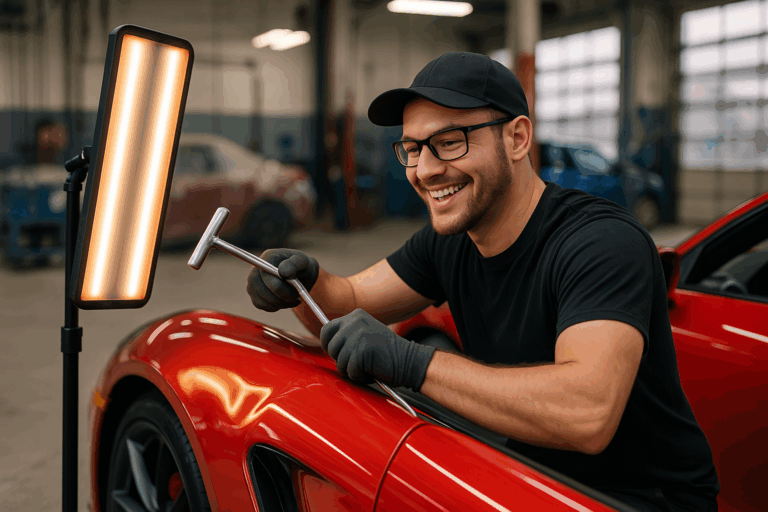
Paintless Dent Repair (PDR) removes dents without repainting—no fillers, sanding, or color matching. Using specialized rods, lifters, and precision lighting, techs massage metal back to its original shape. Because the factory paint stays intact, PDR is typically faster, more affordable, and better for resale value than traditional repairs.
You’ll sometimes see it written as “painteless dent repair”—the correct term is paintless.
Table of Contents
What PDR Can—and Can’t—Fix
Best fits for PDR:
Door dings and parking lot dents
Hail damage repair across hoods, roofs, and trunks
Soft dents on steel or aluminum panels
Some crease dent repair when paint is intact and access exists
When PDR isn’t ideal:
Cracked/chipped paint over the dent
Sharp edge dents with limited access
Structural damage beneath the panel
If you’re unsure, a quick photo estimate usually confirms whether PDR is a go.
The Technician’s Challenge (and Why Software Matters)
As a PDR tech or shop owner, your day isn’t just metal shaping. It’s:
Fast estimates (including accurate hail matrix pricing)
Clear work orders and status tracking
Photo documentation and customer approvals
Invoicing & payments to accounting
Scheduling, dispatch, and multi-tech coordination
Reporting on jobs, panels, pay, and profitability
Doing this with spreadsheets, notes, or ad-hoc apps slows you down—and costs money in missed details and delays.
How a PDR App Levels You Up (Why Pros Use Software)
A modern paintless dent repair software platform like VehicleHub helps you move from lead → estimate → work order → invoice → payment without context switching.
Core workflows you’ll care about:
Photo-to-Estimate: Snap or upload photos; add dent count/size; produce a clean estimate fast.
Hail Matrix Tools: Use insurer-friendly hail matrices; customize panels, counts, and add-ons.
VIN/Plate Capture: Pull vehicle details quickly for accurate records.
Work Orders & Tech Assignment: Convert approved estimates in one tap; track status (“New → In Progress → QC → Complete”).
Mobile Invoicing & Signatures: Collect signatures on-device; send branded invoices instantly.
Integrated Payments: Take payment in person or via link; reduce unpaid jobs.
Accounting Sync: Push invoices and payments to QuickBooks Online (no double entry).
CRM for PDR: Keep customer history, notes, and photos organized for repeat business.
Reporting: Job profitability, tech performance, panel mix, and hail season throughput at a glance.
Team Permissions: Admin, manager, and tech roles (so the right people see the right data).
Bonus for growing teams: VehicleHub integrates with tools many shops already use—like Salesforce Sales Cloud for pipeline visibility for project/task views.
A Day in the Life: PDR Job Flow with VehicleHub
Lead comes in: Customer texts photos → create estimate with contact + vehicle basics.
Estimate in minutes: Apply hail matrix or manual dent count; add labor/add-ons; send digital estimate.
One-tap approval: Customer e-signs; estimate converts to a work order.
Assign & track: Dispatch to a tech; status updates keep everyone in sync.
Repair + QC: Tech logs time, attaches before/after photos, and marks complete.
Invoice & pay: Generate invoice, apply tax/discounts, collect payment on device or via link.
Auto-sync: The job and payment hit QuickBooks; customer gets receipt; CRM updates.
Rinse & repeat: Reports show which panels, job types, or techs drive your best margins.
Solo Techs vs. Multi-Tech Shops: What You’ll Notice
- Solo/Mobile Techs: Faster estimates, fewer no-shows, quick payments, cleaner books, and professional-looking documentation that wins referrals.
Teams & Shops: Standardized pricing, fewer admin mistakes, real-time job status, accurate payroll inputs, and reporting that guides hiring and marketing.
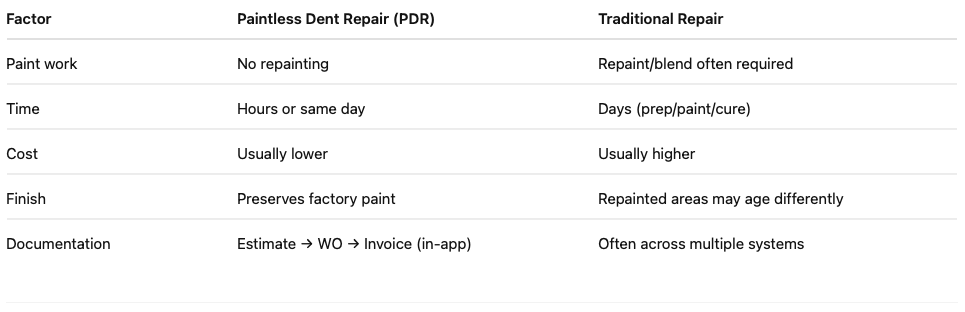
PDR vs. Traditional Body Shop Repair (Quick Comparison)
Step-by-Step: How PDR Works
Inspection – Technician checks dent size, depth, and paint condition.
Access & Lighting – Panels are accessed from behind or with glue-pull techniques; special lights show micro-contours.
Precision Pushing/Pulling – The tech slowly reshapes the metal using dedicated dent removal tools.
Quality Check – Reflections are inspected from multiple angles to ensure a smooth finish.
Mobile Dent Repair (Convenience Option)
Many shops offer mobile dent repair, where a PDR tech comes to your home or office. This is ideal for small door dings or single-panel dents when access and lighting are suitable. Ask if your location and vehicle are good candidates for mobile service.
Will Insurance Cover PDR?
For hail damage repair, insurance coverage usually falls under comprehensive policies. For single dents (like a door ding), it depends on your coverage and deductible. A good shop will help with photos, estimates, and adjuster coordination if needed.
Tips for Choosing a PDR Shop
Experience: Look for certified or highly reviewed technicians.
Before/After Photos: Real examples of similar repairs.
Warranty: Reputable shops guarantee their work.
Transparent Pricing: Clear estimates and timing.
Communication: Willing to review photos and explain your options.
PDR is already the fastest, most paint-safe way to remove dents. Pair it with a purpose-built PDR app and you’ll tighten the rest of your workflow—estimates, hail matrices, work orders, invoicing, and payments—so you can repair more cars in less time.